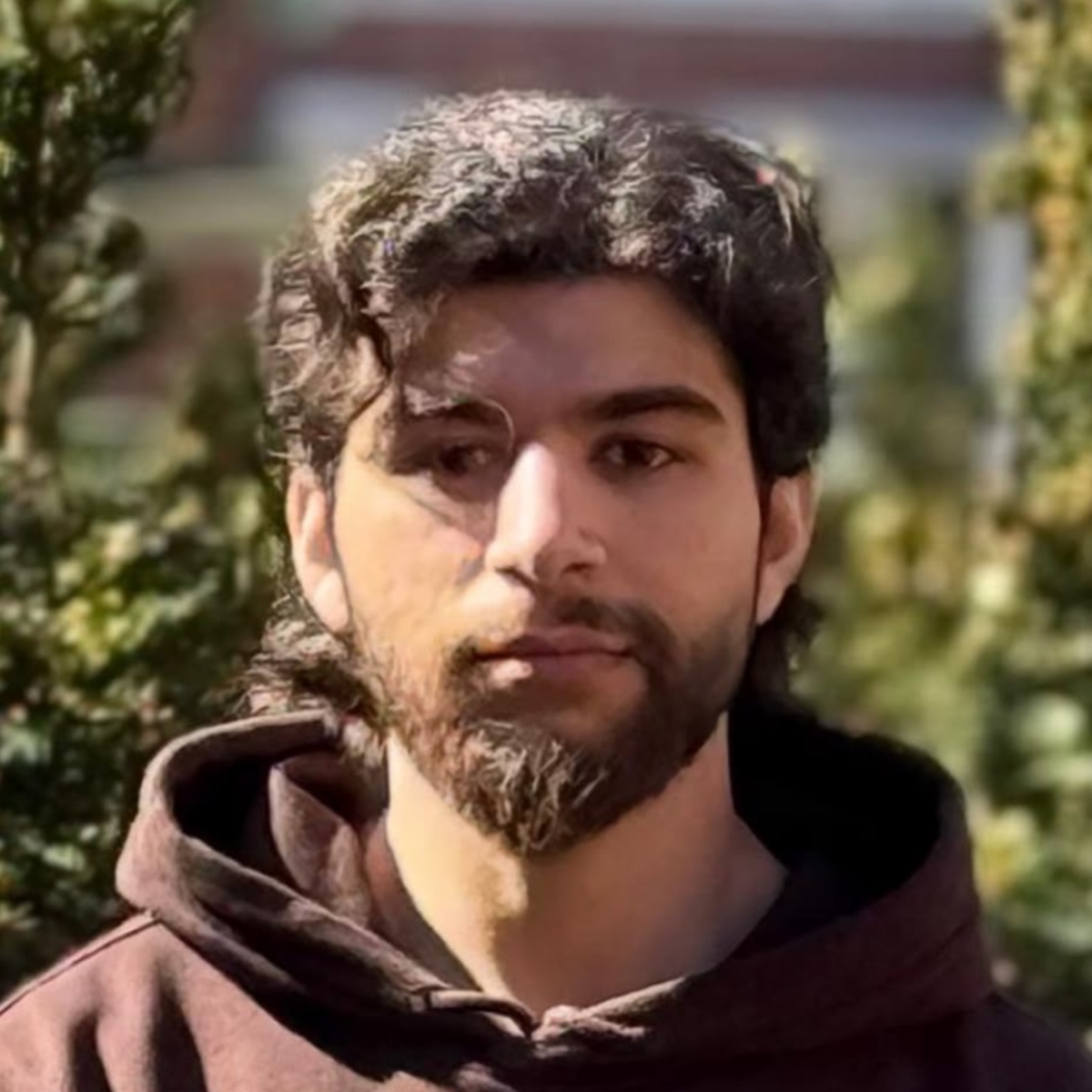
Mohammed Abbas
I'm a Master's student in Robotics and Autonomous Systems at KTH Royal Institute of Technology in Stockholm, where I also studied Electrical Engineering at the bachelor's level. I conducted my bachelor's thesis under Prof. Tobias Oechtering.
I conduct research at the KTH Robotics, Perception and Learning (RPL) lab. My research focuses on spatial intelligence, state estimation and control. I am particularly interested in building and improving world models.
Research
Predictive Sensitivity Across Contact Transitions in a Video World Model
Developed a simulator-grounded causal evaluation framework for iVideoGPT, measuring predictive sensitivity to controlled physical state perturbations around robot-object contact transitions. Reconstructed the VP2 pushing environment in RoboSuite/MuJoCo and built an exact counterfactual pipeline that restores simulator state, applies calibrated object perturbations, re-renders and re-tokenizes frames, and generates matched model rollouts. The results show opposing sensitivity profiles around contact onset and release, confirmed by held-out replication.
Topological State Estimation of Deformable Objects
RPL
This project studies state estimation for deformable garments under partial observability. The goal is to track the evolving 3D state of a garment from sparse multi-view RGB-D observations as manipulation progressively reveals regions that were initially folded or occluded. We use dynamic Gaussian surface representations to reconstruct the cloth over time, and a particle filter to maintain multiple plausible state hypotheses when the observed geometry is ambiguous. A core focus is inferring state from sensor evidence alone, without privileged ground-truth geometry or target-derived preprocessing.
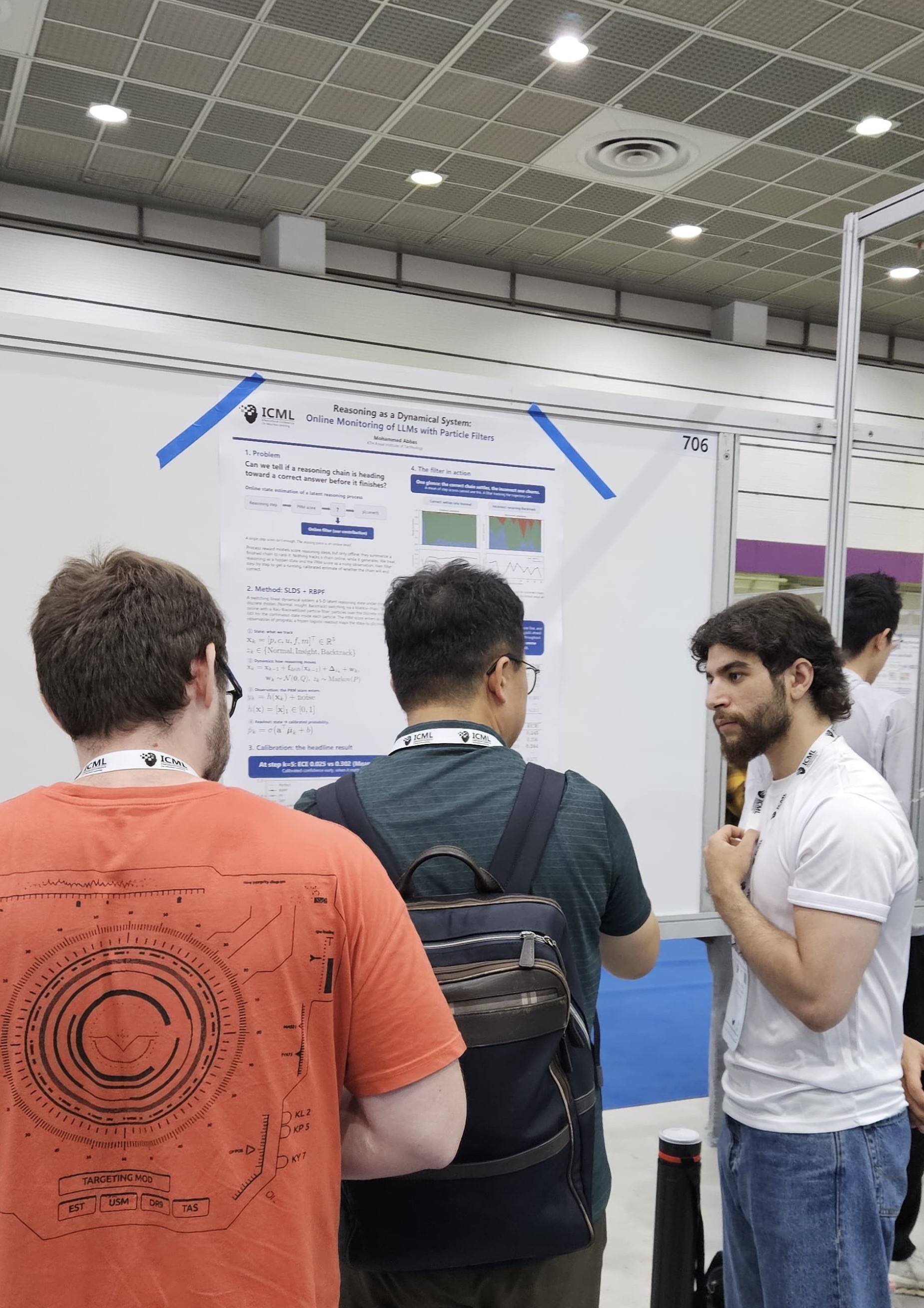
Reasoning as a Dynamical System: Online Monitoring of LLMs with Particle Filters
Sole author
Modeled LLM reasoning as a Switching Linear Dynamical System with three latent modes (Normal, Insight, Backtrack), tracked online with a Rao-Blackwellized Particle Filter that requires no ground-truth labels at test time. Using per-step scores from a Process Reward Model as observations raised AUC from 0.601 to 0.773 on GSM8K, outperforming an online EKF baseline (0.697), and achieved the best calibration of all methods tested (ECE 0.081). Applied to early stopping, the filter preserved 65.2% prediction accuracy while saving 94.5% of reasoning compute, and reached the highest AUC of any method on MATH-500 (0.693).
Privacy-Enhancing Sub-Sampling Meets Model Inversion Attacks
Bachelor's Thesis (with Tomas Matty)
Investigated how optimizer choice and sub-sampling strategy affect vulnerability to model inversion attacks under differential privacy (DP-SGD). Evaluated attack success using classification accuracy, PSNR, and SSIM under a realistic black-box threat model, highlighting trade-offs between semantic privacy and perceptual privacy in reconstructed inputs.
Projects
Einride x KTH AI Society Hackathon
With Tomas Matty and Maichl Hendi
A ROS 2 autonomy stack for a robot operating in a multi-robot delivery challenge. It combines autonomous exploration and SLAM-based mapping with tag-based dock discovery, mission execution, Nav2 navigation, docking, collision monitoring, and recovery. A YOLO11 robot detector and camera/lidar ranging feed particle filters that track nearby robots and predict possible trajectories and destination docks. The stack also includes optional prediction-aware risk and control components, plus a Gazebo-based evaluation harness for measuring deliveries, collisions, and prediction accuracy.
Unite! Research School 2026
Turin and Oropa, Italy
One of 20 students KTH nominated to attend the Unite! Research School, a Blended Intensive Programme organised by Politecnico di Torino with on-site sessions at the Sanctuary of Oropa. The school brought together more than 200 students, researchers, and industry partners from nine European universities for lectures, transferable skills courses, industry panels, research infrastructure visits, and team-based case studies across artificial intelligence, the energy transition, and enabling technologies.